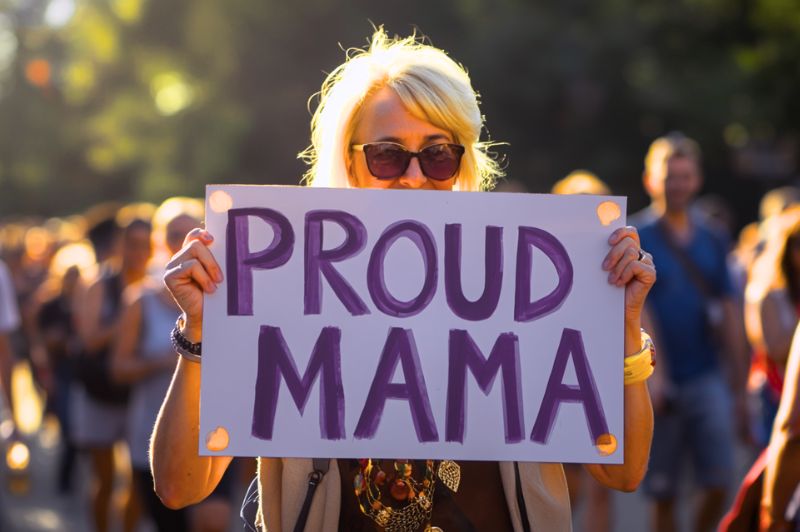
Knowing how to support your gay child can feel impossible at first. One mom, a handmade sign at a Pride parade, and a few tearful strangers changed that.
When Your Child Comes Out
June is Gay Pride Month. Celebrations take place all over the country, celebrating the LGBTQ+ community.
Even those who are not part of the community can show their support as allies. My son is gay, and I enjoy going to Pride events, even without him.
I have worn a sign that says, “I love my children, gay and straight.” Young gay people have approached me in tears, saying how their parents rejected them. They leave the conversation with hugs and smiles.
My son came out as gay when he was in middle school. I knew he was gay from very early in his life. I love him unconditionally, but I feared the tough moments ahead for him, including prejudice and bullying.
I also suffered hurtful remarks from people about my son’s sexuality. A mother at my son’s school learned he was gay and remarked on what a “big cross it must be” for me to bear, sharing that she would pray for me. I was momentarily speechless, then countered that I do not consider it to be a cross, and will pray for her, too. I no longer associate with this person.
More people are coming out as gay or queer today. Some parents do not know how to react when learning their children are gay, though.
How To Support Your Gay Child: Resources That Actually Help
How To Support Your Gay Child: What PFLAG Got Right
PFLAG is the largest organization dedicated to supporting, educating, and advocating for LGBTQ+ people and those who love them. I joined and agree with their tips for supporting LGBTQ children. Their suggestions include leading with love, listening with intention, showing support, and learning the acceptable terms around sexual orientation. You can find PFLAG’s tips for supporting LGBTQ children on their website.
The daughter of Mary M. of Bethesda, Maryland, came out to her in an email. “I had suspected she was gay for years and knew she had been going through a tough time personally, but I wasn’t sure why or how to be there for her,” Mary says. “When I read her words, it was such a relief, and it just was natural to tell her that I couldn’t love her any more than I did and exactly the way she is. I’m so proud of her and treasure her every day.”
It is this type of nonjudgmental acceptance that empowers young people. Dr. Nicole Cutts of Cutts Consulting, LLC in Washington, D.C. confirms that “when a child comes out, what they need most is not judgment or correction, but emotional safety. The child is taking a risk by telling the truth about who they are, and what they are looking for in that moment is some indication that the relationship is still secure. When parents respond with openness, calm, and a willingness to listen, they communicate something far more powerful than any words. They communicate, ‘You are safe here.'”
Dr. Cutts advises that a supportive response might sound like, “‘I’m really glad you told me. Thanks for trusting me. How can I support you?’ and then allowing the child to define what support looks like. When parents demonstrate that their love is not contingent on sexual orientation or gender identity, they create a protective buffer against the external stressors that LGBTQIA youth often face. That kind of affirmation supports resilience, reduces risk for anxiety and depression, and helps the child develop a stable and integrated sense of self.”
What Actually Worked for My Son
I have tried to demonstrate support for my son by educating myself, being available without judgment, and finding ways to help him build his confidence. He loves theater and I provided opportunities for him in those venues, which typically are safe spaces for all types. He continued his passions for performing, becoming an actor, singer, and social media celebrity as a young adult.
If you are still figuring out how you navigate parenting adult children with love, you are not alone in that either.
I strive to be an ally and seek to learn as much as I can about issues facing this community. I hosted an LGBTQIA+ radio show. I wrote articles about issues important to queer folk. I also attend Pride events, which typically are joy-filled, sometimes outlandish, and always fun.
Showing Up at Pride as a Parent Ally
Why Your Presence at Pride Events Matters
Things are changing for gay people. Today it is safer for people to embrace their sexuality than it was in our youth. It is not an easy road for many, however. I still worry when my son travels to states and countries that are known to be conservative.
What each of us can do is strengthen the community by attending Pride events and engaging in positive dialogue. Even our presence speaks. We can help to normalize sexuality of all types, since most prejudice is rooted in fear. After all, most of us can accept that love is love. We all can use more of that.
Did you enjoy this article? Become a Kuel Life Member today to support our Community. Sign-up for our Sunday newsletter and get your content delivered straight to your inbox.

About the Author:
Maria Leonard Olsen is an attorney, author, radio show and podcast host in the Washington, D.C., area. For more information about her work, see www.MariaLeonardOlsen.com and follow her on social media at @fiftyafter50. Her latest book, 50 After 50: Reframing the Next Chapter of Your Life, which has served as a vehicle for helping thousands of women reinvigorate their lives, is offered for sale on this website.