This is a story about midlife intuition and meaning—and why the part of you you once dismissed as impractical may be the most trustworthy guide you have.
Midlife Intuition and Meaning as a Developmental Shift
There was a version of me that marched through the first half of life powered entirely by competence (although confidence mighta been a bit thin on the ground). She trusted schedules, processes, and systems. She valued what could be quantified and optimized. She was, in many ways, the poster child for Western productivity culture: efficient, reliable, structured, indispensable.
Give her a challenge, and she could organize a household, a job, a kid’s school fundraiser, and probably a moon landing. Give her a problem, and she’d engineer a solution. She was a woman who got. sh!t. done. Practical (to a fault) and rooted in the visible, the tactile, the provable.
Her inner motto might as well have been: If it can’t be measured, it doesn’t count. And anything woo was out—firmly out.
And then midlife came calling.
Researchers often describe midlife as a period of “reappraisal,” a stage when previously stable identities begin to shift, and women experience increased introspection, meaning-seeking, and a desire for authenticity (Lachman, 2015; Bianchi, 2016). In other words, the practical woman meets the deeper self.
And for many of us, that deeper self turns out to be … well, maybe we call it woo-curious.
At first, it felt like a vague discomfort—like my scaffolding no longer fit the architecture of my inner life. And then, the questions got louder, and the old ways of eternally striving felt heavier. More and more, it felt as though I had outgrown the box I had once so proudly packed myself into.
We may think we outgrow magic when we become adults. And then, sometime in our forties or fifties (and often right when our practical skills are at their peak), magic circles back and taps us on the shoulder.
Midlife, it seems, is when the woo comes calling.
The Slow Unfurling
For me, the shift wasn’t a switch flipping; instead, it was a gradual erosion: a slow, steady reshaping of the landscape of my inner life. The practical part of me didn’t disappear; she simply began to soften, to make space for more.
It began as a nameless longing—something not quite filled by productivity, purpose, or (gasp) even accomplishment. What I wanted was meaning—not the kind you can bullet-point or optimize, but the kind you feel whispering in your blood and bones.
Around that time, I discovered David Whyte’s writing, which he often uses in workshops to explore identity, transitions, and the recovery of soulfulness in adulthood (Whyte, 2001; Whyte, 2014). Reading his poetry in particular, I felt something shift. Something ancient, feminine, and utterly impractical.
It unsettled me. And it also felt like home.
Developmental psychologists have long observed that midlife is prime time for “eudaimonic growth,” the pursuit of meaning, purpose, and alignment with one’s true self (Ryff, 2014).
In other words, the woo wasn’t arriving. It had always been there, just waiting to step forward.
Enter the Hag
Not long after, I picked up Sharon Blackie’s Hagitude—a book grounded in folklore, archetypal psychology, and women’s life-course research. Blackie’s thesis aligns with emerging scholarship on how mythic narratives provide women with alternative, empowering developmental pathways in midlife and beyond (Blackie, 2022; Downing, 2017).
Blackie reclaims the archetype of the hag—not the caricatured, one-dimensional crone of fairy tales but the wise, wild, ambiguous woman who lives at the edges and speaks the language of intuition. One who carries ecological and ancestral wisdom, who is ungoverned by social expectations.
This reframing resonated deeply because it paralleled what I was witnessing in myself: the realization that the “good girl” and “competent woman” identities of early adulthood had run their course.
The hag is not practical—and she is the woman who finally stops performing and starts remembering and embodying the power she put aside. It was time to own the crone.
Blackie confirms that midlife is not a narrowing, but an initiation. Not a time to fix our broken (because we’re not broken) but an unfurling of our wholeness. It’s a time when we’re invited to step away from what has always worked (because has it, really?) and to claim the deeper gifts we’ve always carried and rarely honored.
And so I began to wonder, what if the woo is not frivolous at all—but simply another language I’d never been taught to speak?
The Psychology of the Woo (Yes, It Exists)
The qualities we often label “woo” actually map onto well-studied psychological constructs.
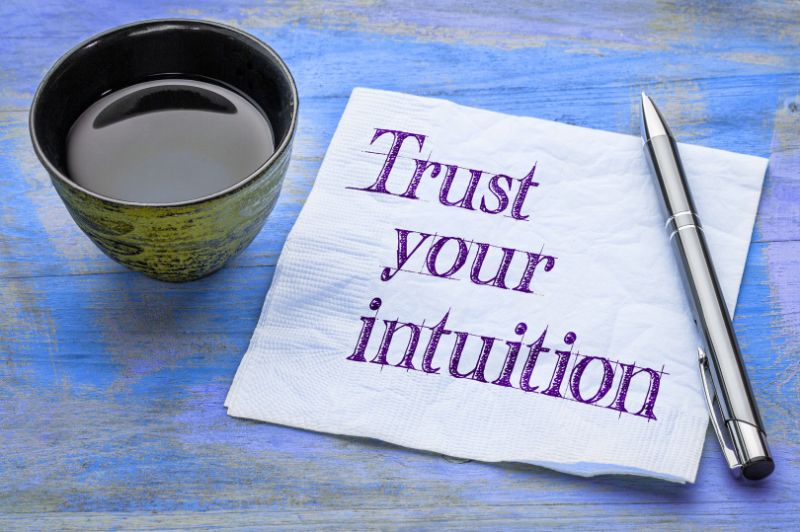
1. Intuition
Cognitive scientists describe intuition as a form of rapid, experience-based decision-making that bypasses conscious analysis (Gigerenzer, 2007). Women in midlife often report a strengthened intuitive capacity due to accumulated life experience and increased self-trust (Merrill & Rubenstein, 2019).
2. Embodiment
Somatic psychology finds that the body stores emotional and experiential information and often “speaks” before the conscious mind does (van der Kolk, 2014). Many midlife women learn to interpret these physical and emotional messages more accurately after decades of ignoring them.
3. Meaning-making + Spiritual Curiosity
Longitudinal studies show that spirituality—not necessarily religion—often increases in midlife as women seek deeper coherence and purpose (Wink & Dillon, 2008).
So the woo isn’t irrational—it’s trans-rational: the kind of knowing that includes logic and intuition, structure and mystery.
The Courage to Claim What Has Always Been Mine
Claiming my gift didn’t feel like winning a prize: it felt more like finding something I’d dropped years ago and only just noticed was missing.
At midlife, many women begin to recognize that the “practical” part of us—the part that keeps households afloat, supports partners and children, manages work and community responsibilities—is not the opposite of the woo. It’s complementary to it.
Researchers call this “integration”—the blending of cognitive, emotional, and spiritual intelligences that often peaks in midlife (Sinnott, 2013). It’s a shift from what psychologist James Hollis calls “ego-driven living” to “soul-driven living” (Hollis, 2005).
Practicality without soul makes us brittle; woo without grounding becomes drift. Midlife teaches us how to weave the two together.
For me, that looks like:
- Listening to my intuition with the same seriousness I once reserved for data.
- Building rituals as readily as I once constructed meal plans.
- Trusting my inner rhythms more than external expectations.
- Allowing myself to be guided—not just by strategy, but even more by synchronicity.
I still love spreadsheets. I still manage a household, a business, a family’s worth of logistics. But those tools no longer define me. They support me. Now there’s another dimension woven through everything: a willingness to follow the quiet tug of the unseen, a belief that magic is simply what happens when the practical and the soulful join hands.
So if something inside you is awakening—pay attention. If something is tugging—follow it.
If something is calling—answer it.
Claim the woo because it is yours, because it is time, and because the world needs women who are finally—and fully—becoming themselves and stepping into their sovereignty. Join me there!
References
- Bianchi, S. M. (2016). Family change and time allocation in American families. The ANNALS of the American Academy of Political and Social Science, 669(1), 21–44.
- Blackie, S. (2022). Hagitude: Reimagining the second half of life. House of Anansi Press.
- Downing, C. (2017). The goddess: Mythological images of the feminine. Shambhala.
- Gigerenzer, G. (2007). Gut feelings: The intelligence of the unconscious. Viking.
- Hollis, J. (2005). Finding meaning in the second half of life. Gotham Books.
- Lachman, M. E. (2015). Mind the midlife gap. Psychological Science in the Public Interest, 16(2), 1–72.
- Merrill, N., & Rubenstein, C. (2019). Life experience and intuitive decision-making in midlife women. Journal of Adult Development, 26(4), 205–215.
- Ryff, C. (2014). Psychological well-being revisited: Advances in the science and practice of eudaimonia. Psychotherapy and Psychosomatics, 83(1), 10–28.
- van der Kolk, B. (2014). The body keeps the score. Viking.
- Whyte, D. (2001). Crossing the Unknown Sea. Riverhead Books.
- Whyte, D. (2014). Consolations: The solace, nourishment and underlying meaning of everyday words. Many Rivers Press.
- Wink, P., & Dillon, M. (2008). In the course of a lifetime: Tracing religious belief, practice, and change. University of California Press.
- Sinnott, J. D. (2013). Adult development and aging. Wadsworth.
Did you enjoy this article? Become a Kuel Life Member today to support our Community. Sign-up for our Sunday newsletter and get your content delivered straight to your inbox.

About the Author:
Liza is a certified Integrative Nutrition® Health Coach, author, and passionate advocate for women’s wellness in perimenopause and beyond.
Her EAT | Your Way to Health™ and Stewarding Emotional Eating™ programs support women in renegotiating their relationship with food, stress, and themselves, finally coming into full alignment their intuition and entering a season of sacred harvest in place of decline.
You can learn more about Liza here: www.simplyhealthcoaching.com