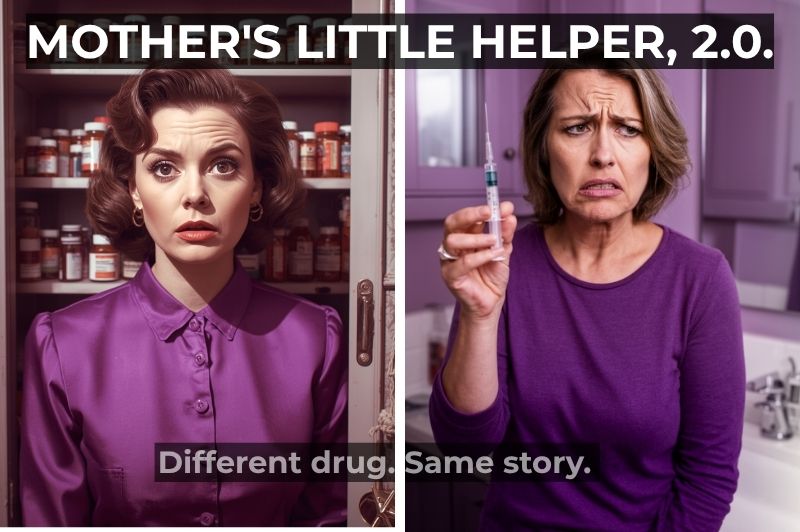
Ozempic and menopause. We need to talk.
I almost asked my doctor about micro-dosing Ozempic.
Not for weight loss. That’s what I told myself, anyway. For inflammation. I’d read something about GLP-1s and systemic inflammation, the kind that quietly wrecks joints and accelerates aging. Which is true. Also true: I’ve got a number in my head. The weight gain that would move this from “interesting research” to “actual conversation with my doctor.” I’m ten pounds closer to that number than I was a few months ago. I don’t love admitting that. But here we are.
Then I found out that the drug I was casually considering, the one one in five women my age is already taking, the single most concentrated adopter group of any demographic in the country, has almost no research on what it does to a perimenopausal body beyond weight loss. They did study women. Mostly white, average age 47, largely pre-menopausal. Then they handed it to a different body entirely and apparently figured someone else would sort out the details later. No one did. This is not an accident. It took until 1993 for the NIH to require women be included in clinical trials at all. Nineteen. Ninety. Three. The research gap isn’t an oversight. It’s a policy.
To be fair, one study went back and checked the data. Found the drug works for weight loss across reproductive stages. Three of its authors work for the company that makes it. And that drug? Tirzepatide. Not semaglutide. Not Ozempic. The one your doctor is most likely handing you. Muscle loss, bone density, hormonal impact? Still not asked. Still not answered.
We are not a footnote in the GLP-1 story. We are the story. And the research gap isn’t a gap. It’s a wall.
I sat with that for a minute.
This Has Happened Before
What Ozempic and Menopause Have In Common With Valium
It was the 1960s. A little yellow pill called Valium showed up, and doctors handed it to women at twice the rate they handed it to men. Ninety million bottles a year, at its peak. The Rolling Stones called it in 1966. Named the whole zeitgeist in three words: Mother’s Little Helper. The ads didn’t disagree. Women, lonely and anxious, saved from their disappointing lives by a little yellow pill. Progress.
Most of those women were in real pain, by the way. They weren’t hysterical. They weren’t imagining it. They were suffering, and instead of anyone asking why, they got something to quiet them down.
It took until the late 1970s, when Betty Ford went public about her prescription drug addiction and Senate hearings finally put Valium on trial, for anyone in power to pay attention. And even then, the panic wasn’t really about women’s health. It was about the optics of nice, respectable women becoming addicts.
Sixty years later, the pill became a needle.
The Question Nobody Is Asking Out Loud
Here’s what nobody is telling these women. Not their doctors. Not the pharmaceutical companies. Not the insurance companies gleefully denying coverage one month and approving it the next.
The information needed to make a fully informed decision about what this drug does to a perimenopausal body beyond weight loss doesn’t exist yet.
Think about what informed consent actually means. It means someone hands you the full picture and you decide. My pellet protocol has a form. I sign it every time. It is not a cheerful document. It basically says: here are the ways this could go badly, sign here if you still want to proceed. I sign it. Every time. Because I know what I’m agreeing to and why. That’s informed consent. Scary as hell, but honest.
Now imagine asking your doctor about the specific risks of a GLP-1 on a perimenopausal body. On muscle mass, already shrinking as estrogen drops. On bone density, already declining. On the hormonal chaos of navigating all of it simultaneously. Your doctor cannot tell you. Not because they’re a bad doctor. Because no one has studied it. The medication guide they hand you covers nausea and thyroid risk. It does not cover what nobody has bothered to find out.
The most significant muscle loss study on GLP-1s? Conducted on mice and men. Not women. The drug is being taken primarily by women. They studied mice. We’re still waiting.
And here’s the part that keeps me up at night. Even the woman who reads everything, asks every question, does all her homework, cannot be truly informed. Because a medical system that cannot answer the most basic questions about what this drug does to our specific bodies beyond weight loss is handing it to us at a higher rate than any other population on earth. And calling it progress. Still.
What Changed And What Didn’t
In the 1960s, the system medicated women to make them calm.
Now women are fighting insurance companies at twelve hundred dollars a month for access to a drug that finally makes them feel like themselves again.
The target shifted. The logic of the system didn’t. The goal was always making women easier to look at, one way or another. But the women taking this drug aren’t chasing a number. They’re chasing themselves back.
We have been here before, fighting for the right to be taken seriously in our own bodies, and somehow we keep ending up in the same place.
Turns out Mother’s Little Helper has a sequel.
I just didn’t expect to recognize myself in it.
Sources:
- RAND Corporation Commentary, August 2025
“GLP-1 Agonists in Perimenopause: Unique Risks and Potential Opportunities” - Consumer Affairs, August 2025
“GLP-1 Use Surges Among Perimenopausal Women But Research Hasn’t Kept Up” - PubMed / Obesity Journal, March 2025
“Body Weight Reduction in Women Treated with Tirzepatide by Reproductive Stage” - JSTOR Daily
“Just Saying No to Valium” - History Hit
“Mother’s Little Helper: The History of Valium” - Biography.com
“How Betty Ford Tackled the Taboo of Addiction” - Encyclopedia.com
“Valium” - Wikipedia
“Mother’s Little Helper” - FDA Prescribing Information / Wegovy Medication Guide
Wegovy Prescribing Information and Medication Guide - Brigham and Women’s Hospital / NIH Revitalization Act 1993
NIH Revitalization Act of 1993 - Cell Reports Medicine, March 2026
“Weight loss with GLP-1 medicines does not result in a disproportionate loss of muscle mass or function in obese mice and humans” - Insurance cost and denial documentation
ABC News | ValuePenguin | Oana Health
Did you enjoy this article? Become a Kuel Life Member today to support our Community. Sign-up for our Sunday newsletter and get your content delivered straight to your inbox.