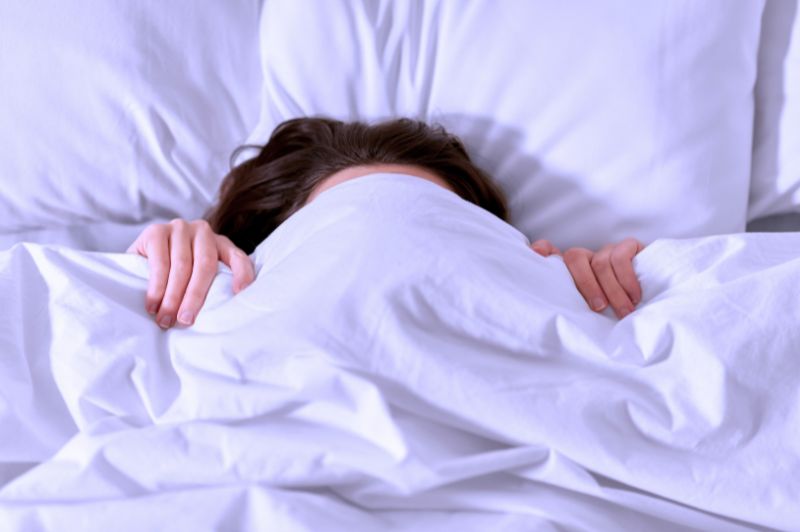
It’s 3:12 a.m. You know because you checked. You already gave up the afternoon latte, bought the cooling pillow and read up on foods that help hormone imbalance insomnia. And here you are again, wide awake, listening to the house settle.
Most sleep advice stops at your hormones. Fair enough, they’re probably what wakes you. But a menopause-friendly bedroom often decides whether you drift off again in two minutes or stare at the ceiling until the birds start up. And that room answers to you.
What Actually Wakes You at 3 A.M.
Start with the baseline. The National Institute on Aging says older adults need the same seven to nine hours as everyone else, but sleep tends to get shorter and lighter with age, and you may wake more often during the night. Nobody asked your permission. It just happened.
Menopause stacks on top of that. In a 2025 American Academy of Sleep Medicine survey, 37% of women 45 to 64 said they wake frequently at night, and 35% said hot flashes or night sweats disrupt their sleep. Only 6% said menopause hadn’t changed their sleep at all. If you’re in that 6%, congratulations. Feel free to skip ahead while the rest of us talk.
A 2016 study in the Journal of Clinical Sleep Medicine tracked women’s hot flashes and awakenings overnight. About two-thirds of the hot flashes happened within five minutes of waking up. The wake-up is usually short. The trouble starts in the minutes after.
Why a Two-Minute Wake-Up Turns Into an Hour
A brief awakening is survivable. You flip the pillow, kick a foot out from under the duvet, and you’re gone again unless something in the room catches your attention while you’re surfacing. A scratch inside the wall, maybe, or a rustle you can’t place.
Let that happen enough nights, and your brain makes a deal you never signed. Sleep specialists call it conditioned arousal, where the bed turns into a cue for alertness instead of sleep. Insomnia treatment, like the stimulus control approach used at Stanford Health Care, works to break exactly that link.
And plenty of us have been running a night watch for decades. Listening for the baby. Then for the teenager’s car in the driveway. Then for the phone call about a parent. Your brain already knows how to keep one ear open. Noises you can’t predict give it every reason to keep doing it, because you never know if tonight is the night you’ll hear them again.
The Roommates You Didn’t Invite
Of everything that can catch you in that half-awake window, rodents are the worst offenders, because they keep your hours. Mice are most active at night, which is precisely when a light sleeper is easiest to rouse.
They also leave behind things you can’t hear. A national survey reported by the National Institute of Environmental Health Sciences found mouse allergen in 82% of U.S. homes, and the dust samples included beds and bedroom floors. Add dust mites, which settle into bedding and anything else that gathers dust, and your bedroom can work against you even on the nights when nothing scratches.
Then there’s the worry. A small study of Montreal apartment tenants found that people living with bed bugs had five times the odds of sleep disturbance and nearly five times the odds of anxiety symptoms, compared with tenants who didn’t have them. It’s 91 people, so hold it loosely, though anyone who has lain awake waiting for the next sound won’t need convincing.
How to Build a Menopause-Friendly Bedroom That Answers to You
None of this calls for a renovation. These changes help with sleep and pests at the same time:
- Eat the bedtime snack in the kitchen. Crumbs on the nightstand are an open invitation, and the NIA already suggests skipping large meals two to three hours before bed.
- Clear out under the bed. Mayo Clinic puts it plainly: if it collects dust, it collects dust mites. Bins and piles of clothes also give mice a place to hide.
- Put the mattress and pillows in allergen-blocking covers, and wash sheets and pillowcases in water that’s at least 130°F.
- Find your own temperature. The usual advice is about 65°F, according to the Sleep Foundation. But a 2023 Harvard-affiliated study of older adults found they slept most efficiently between 68 and 77°F. If night sweats run your nights, Cleveland Clinic suggests a fan and light layers you can add or shed. Try a setting for a week and go with what your body reports, not what a listicle says.
- Seal before you spray. A can of bug spray on the nightstand means sleeping next to whatever’s in it. If you’re cutting back on household chemicals, our guide to breaking free from chemical chaos is a good place to start.
Keep Rodents Out of the Bedroom for Good
This is the unglamorous part, and it’s the part that works. According to the CDC, a mouse can squeeze through a hole about a quarter inch wide, the width of a pencil. Check where pipes come in under sinks, around floor vents, and anywhere electrical, gas, or water lines pass through a wall. The CDC recommends packing small gaps with steel wool, then sealing around it with caulk or spray foam.
Know the signs: droppings, fresh gnaw marks, tracks, and a musky smell. If you’re finding them in more than one room, or the scratching comes from the same spot night after night, a trap by the fridge won’t settle it. A trap catches the mouse, but the gap it came through is still sitting there for the next one.
That’s when it’s worth calling in help. Wherever you live, look for a service that starts with an inspection to find the entry points, seals them, and comes back to confirm the activity has stopped. In the Toronto area, professional rat control for homes is one example of that approach. If a company only wants to talk about bait, keep looking.
Hormones Get a Vote. They Don’t Get the Whole Room.
You can’t negotiate with a hot flash. You can decide what it wakes you up to. A room set to your number, not somebody else’s. Walls with no gaps and nothing scratching inside them. Better sleep after 50 is mostly a stack of small, stubborn decisions, and the biggest one is refusing to share your nights with anything you didn’t invite.
And if you’ve done all of this and you’re still up at 3 a.m. most nights, take that to your doctor. The NIA notes that insomnia is the most common sleep problem in adults over 60, and that cognitive behavioral therapy can help.
Disclaimer: The information in this article is not intended to diagnose or treat any medical condition. Consult a qualified healthcare provider about persistent sleep problems, menopause symptoms, or allergies.
Did you enjoy this contributed article? This post contains affiliate links. Sign-up for our Sunday newsletter and get your expert content delivered straight to your inbox.