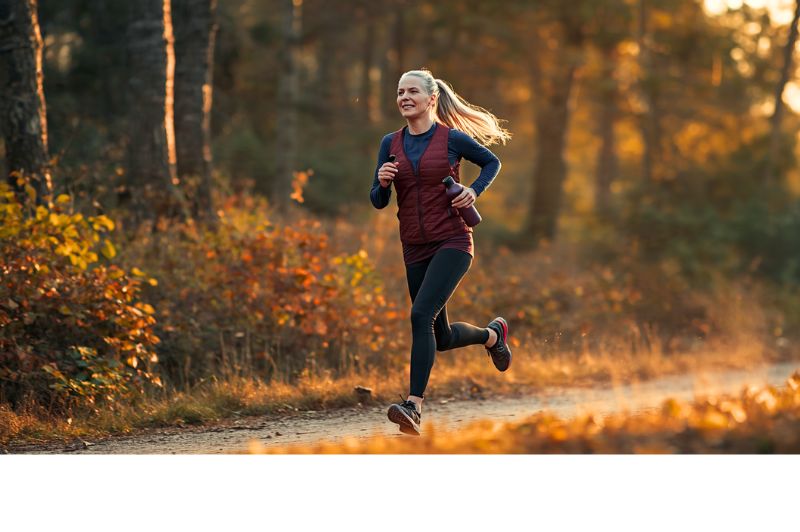
Go looking for advice on running recovery after menopause and you’ll find a lot of certainty. Eat this within 30 minutes. Drink that. Hit this exact protein number. It all sounds very official until you ask who it was tested on.
Mostly men. Women make up about 34% of the people studied in sport and exercise science, and only around 6% of studies look at women alone, according to an editorial in the British Journal of Sports Medicine. Its authors say women in midlife and beyond barely show up at all.
You could get mad about that. Or you could notice what it means: for a woman running through her 50s and 60s, a lot of the real answers haven’t been written yet. You’re not behind the research. You’re ahead of it. So take what follows as a starting point, and take yourself seriously as the study.
What the Studies Say About Running Recovery After Menopause
The protein target you’ll see quoted for older athletes, about 0.40 grams per kilogram of body weight per meal, comes from a 2015 pooled analysis of six studies, all in men. Younger men topped out closer to 0.24 grams, though measured against body weight, the gap between the groups wasn’t statistically significant.
When researchers tested women, it got murkier. In a 2024 trial, 16 postmenopausal women did resistance exercise and then drank 15 grams of whey protein. The protein did nothing measurable for muscle protein synthesis. The workout did. A 2026 review calls the evidence on menopause and muscle thin and mixed, and found that nobody has directly compared muscle building after exercise in women before and after menopause.
Nearly all of this work used weight training, not running. So every protein rule you’ve read for your long run is, at best, an educated guess.
The most useful educated guess comes from the International Society of Sports Nutrition, which suggests women in and after menopause aim for the higher end of 1.4 to 2.2 grams of protein per kilogram a day. At 140 pounds, that’s roughly 90 to 140 grams. Yes, that’s a lot of eggs. Our piece on the importance of protein for women over 50 explains why it’s worth the effort.
The same group also advises women in and after menopause to track their own training and recovery to find their patterns. In other words, the experts are handing you the clipboard.
The First Hour: Carbs You Can Actually Stomach
A long run empties your carbohydrate stores, and your stomach may not care. You don’t owe anyone a full plate the second you walk in the door.
A banana is the lowest-effort start there is, and it brings 422 milligrams of potassium, according to the NIH Office of Dietary Supplements. Juice works too. If chewing anything feels ambitious, eat energy gummies or sip something on the walk back to the car, and save the real meal for when your appetite shows up.
Potatoes deserve more credit than they get. A medium baked potato has 610 milligrams of potassium in the flesh alone, per the same NIH fact sheet.
One more first-hour detail nobody mentions: women in menopause clear water more slowly, which can make low blood sodium more likely, according to the same sports nutrition position stand. If you tend to drink a lot after long runs, electrolytes are worth a conversation with your doctor.
The Foods Worth Testing
None of these are rules. They’re options with decent reasons behind them, and your body gets the final vote.
Greek Yogurt
Protein and calcium in one cup, and calcium matters more after 50. For reference, 8 ounces of plain low-fat yogurt has 415 milligrams of calcium, per the NIH calcium fact sheet. Honey and oats on top cover the carbs. Notice how it sits after a hard effort. Some stomachs welcome dairy after a run, and some file a formal complaint.
Eggs
A University of Illinois study found that 18 grams of protein from whole eggs after a workout produced a 40% bigger muscle-building response than the same amount from egg whites. The subjects were 10 young men. A 12-week trial in trained men then found whole eggs and whites led to about the same gains in muscle and strength. So the great yolk debate is unsettled, and nobody has run it on women our age. Eggs are cheap and fast either way. Eat the yolk if you like the yolk.
Chocolate Milk
It gets treated like the official recovery drink. A 2019 meta-analysis of 12 studies was less impressed. Overall it did about as well as placebo or sports drinks, and the authors called the evidence limited. If you love it, drink it, and enjoy the 299 milligrams of calcium in a cup of nonfat milk. Just don’t expect a miracle in a carton.
Salmon
This is your vitamin D pick. Three ounces of cooked sockeye has about 570 IU, according to the NIH vitamin D fact sheet, and canned pink salmon with the soft bones left in adds 181 milligrams of calcium per 3 ounces.
Cottage Cheese
It’s mostly casein, a slow-digesting protein, which makes it a contender for the bedtime experiment below. If you’re watching your blood pressure, check the sodium on the label.
Your Bones Are Recovering Too
A study built on men will never show you this. Women can lose up to 20% of their bone density in the five to seven years after menopause, according to the Bone Health and Osteoporosis Foundation. Your muscles aren’t the only thing asking to be fed.
The NIH puts calcium at 1,200 milligrams a day for women 51 and older (men get 1,000 until after 70) and vitamin D at 600 IU through age 70, then 800. Yogurt, milk and canned salmon pull double duty here. If you’ve never had a scan, here’s why tracking bone density after menopause is worth your time. It’s data about you, which is the whole point.
Two Experiments Worth Running
Tart Cherry Juice
In a study of 20 recreational marathon runners, those who drank tart cherry juice for five days before the race, on race day and for two days after got their strength back faster than the placebo group. A follow-up pilot found that none of the cherry juice drinkers reported cold-like upper respiratory symptoms in the two days after the marathon, while half the placebo group did, as Women’s Running reported. Two small studies, 20 runners each, about eight days of juice around race day. Promising, not proven.
Protein Before Bed
In a trial of 48 men averaging 72 years old, 40 grams of casein before sleep raised overnight muscle protein synthesis compared with placebo. A 2021 study of 36 older men found casein alone didn’t improve overnight repair of muscle connective tissue, but casein after an evening resistance workout did. That’s one more argument for picking up weights between runs, and our piece on why strength training matters for runners over 45 makes the full case. Cottage cheese or Greek yogurt is the real-food version.
Run Your Own Study
The research will catch up eventually. Until then, you have the one data set nobody else has: your own body. A few ways to put it to work:
- Keep a simple log after long runs: what you ate, when, how your legs felt the next day, how you slept.
- Change one thing at a time and give it a few weeks. A protein-forward breakfast is an easy first experiment.
- Notice what your stomach tolerates in that first hour, and stop forcing what it doesn’t.
- Get a bone density baseline so you know where you’re starting.
- Keep what works and drop what doesn’t. You’re the lead researcher here.
Disclaimer: This article is for general information only and is not medical or nutrition advice. Talk with your doctor or a registered dietitian before changing how you eat, especially if you manage a health condition or take medication.
Did you enjoy this contributed article? This post contains affiliate links. Sign-up for our Sunday newsletter and get your expert content delivered straight to your inbox.