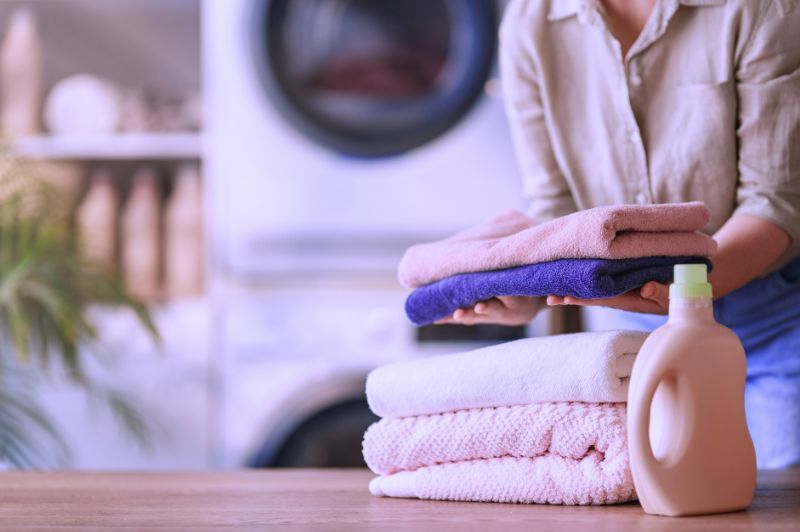
Why laundry detergent irritates menopause skin is a question more women are asking in their 50s, and the answer is not that you have become more fragile. Your skin’s chemistry has changed, and the detergent that ignored you for twenty years no longer returns the favor.
For most of us, laundry was an autopilot errand for decades. Grab the same bottle, load the machine, move on. But somewhere in the midlife shuffle, the skin you used to ignore started having opinions. Fragrances that never bothered you now leave you itchy by afternoon. A wardrobe that used to live in one wash temperature now includes gym fabrics, delicate linens, dark clothes from a capsule wardrobe you actually invested in, and bedding you are finally treating like it matters. The household may have gotten smaller, but the laundry decisions have not.
This is where most generic laundry advice falls apart. It is written for a hypothetical household of four with muddy kids and a predictable routine. That may not be your life anymore, and it definitely does not account for what midlife does to your body, your priorities, or your patience for products that do not hold up.
Why Laundry Detergent Irritates Menopause Skin
Estrogen decline does real things to skin. It gets thinner, drier, and more reactive. Fragrances and synthetic dyes that sat quietly on clothing for years can become a source of low-grade irritation you cannot quite trace to anything obvious. Board-certified dermatologist Dr. Marianna Blyumin-Karasik describes these reactions plainly: red, itchy, burning rashes in areas where clothing contacts skin the most. The fix is often the same: move to a fragrance-free, dye-free formula and see what happens. Many women are surprised how much of what they attributed to dry skin or stress clears up when they switch detergents.
If you want a guide for comparing ingredient lists, the U.S. Environmental Protection Agency’s Safer Choice program is a reliable reference. It is not a complete picture of every good product out there, and a label does not guarantee a product will work for your specific skin chemistry. But it is a credible starting point when you want to understand what is actually in the bottle.
Match the Formula to What You Actually Wash
The best laundry detergent for your household is the one that fits what you wash, not what the marketing copy says. Start there.
If your wash is mostly sheets, towels, and everyday clothing in mixed loads, a good universal formula handles that well. For darker or more saturated clothing where you care about the color holding, a color-care detergent does what it promises. If perimenopause skin irritation is a real factor, that consideration moves to the top of the list regardless of everything else.
For shoppers who want to compare formulas side by side, especially if you prefer imported options with a different range of product types, Persil detergent from Germany is worth knowing about. German market ranges separate products by specific use case, covering universal, color-care, sensitive, powder, gel, and compact formats. That structure makes it easier to see what you are actually choosing between rather than just picking by scent or price point.
The Format Question Is More Practical Than You Think
Pods and discs are convenient, but they are not adjustable. A lightly soiled small load and a heavily soiled king-size comforter do not need the same amount of detergent. Pre-measured formats make that call for you, and the call is not always right.
Liquid or powder detergents give you more control over dosing, which matters if you have a high-efficiency machine or tend to run smaller loads now that the household has changed. More detergent does not mean cleaner laundry. Residue buildup in a HE washer is a real problem and it starts with consistently overdosing, which also means more irritating residue sitting against your skin all day.
Compact concentrated formats work well if storage space has gotten tighter. A smaller apartment, a laundry closet, a house where you have deliberately reduced the square footage you maintain: concentrated options mean fewer large jugs taking up room.
Stains Deserve a Better Strategy Than Just Adding More Detergent
The most consistent laundry mistake is treating detergent as the answer to everything. It is not. Stains respond better to quick treatment than to extra detergent thrown into a load two days later. Body oils, wine, food, and makeup each respond differently. What they share is this: the dryer is not your friend. Heat sets stains in ways that are genuinely difficult to reverse, so if something did not come out clean in the wash, do not automatically dry it.
Keep a stain-specific product on the shelf. Treat visible stains before the item goes in the machine. Follow the dosing guide on your detergent rather than estimating. These three habits will outperform any detergent upgrade you could make.
If you are interested in reducing the number of products cluttering your laundry area, Kuel Life has looked at this before. Citric acid as a household cleaning alternative is worth reading if you are open to rethinking what actually needs to be on your shelf.
Build a Simple System Instead of a Full Shelf
Most midlife households do not need eight laundry products. A practical setup includes one everyday detergent, one color-care formula if darker clothing is a regular part of the rotation, a fragrance-free detergent if menopause skin sensitivity is a factor, and one stain treatment product for problem loads. That is it.
The goal is a laundry routine that works without requiring a lot of management. You have enough decisions to make. This one should not take more than a few minutes of thinking once and then running on mostly automatic from there, adjusted when something stops working.
Clothes and bedding are in contact with your skin for most of your waking and sleeping hours. What you wash them with is not a trivial choice. It just does not have to be a complicated one, either.
Did you enjoy this contributed article? This post contains affiliate links. Sign-up for our Sunday newsletter and get your expert content delivered straight to your inbox.